World Cup History:England Stand on the Brink of History -But History Alone Wins Nothing
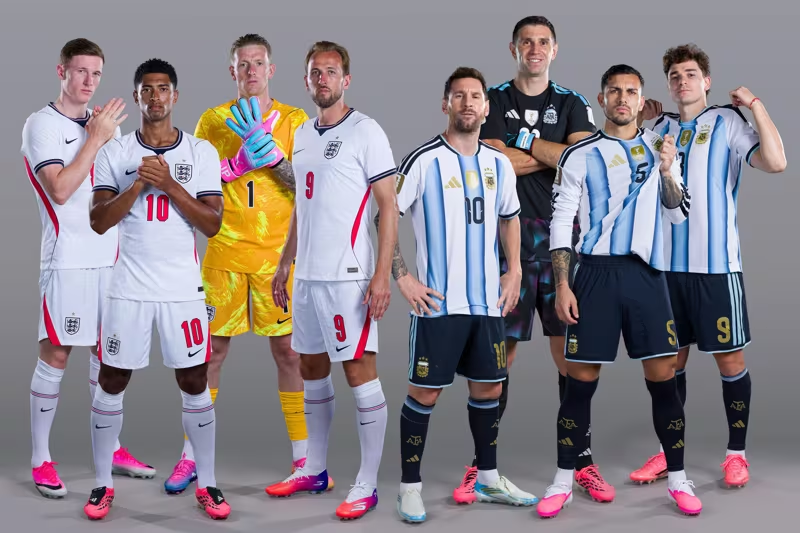
 Photo : FIFA Composite
By Wakirike Herald Sports Desk
Football has a peculiar relationship with history.
It remembers triumphs for generations but preserves heartbreak even longer.
For England, every World Cup campaign has lived in the shadow of 1966, the year Sir Alf Ramsey's men lifted the Jules Rimet Trophy at Wembley and etched their names into football folklore. Nearly six decades later, another England side stands within touching distance of rewriting history.
A World Cup semi-final against Argentina is more than another football match.
It is a collision of history, rivalry, redemption, and destiny.
If England prevail, they will reach their first FIFA World Cup final in sixty years. If they fall, another talented generation risks joining the long list of England teams remembered more for what might have been than for what they achieved.
Living With the Weight of Expectation
Few football nations carry the burden of expectation quite like England.
Every major tournament begins with hope.
Every knockout victory fuels belief.
Every defeat reopens old wounds.
Since 1966, England have repeatedly come close without reaching the summit. The semi-final defeat to West Germany in 1990, the heartbreaking exit to Croatia in 2018, and successive UEFA European Championship final losses have reinforced an uncomfortable reputation—that England are masters of promise but strangers to ultimate success.
That narrative has become increasingly unfair.
Modern England are no longer tournament underachievers.
They are consistent contenders.
Yet elite sport is often unforgiving. Consistency earns respect, but trophies create legends.
A Different England
This team feels different.
Not because England possess extraordinary individual talent—they have done so before.
Not because expectations are lower—they certainly are not.
The difference lies in belief.
Under Thomas Tuchel, England appear to have embraced the mentality required to navigate football's most unforgiving moments. Tournament football is rarely beautiful. It demands resilience, discipline, tactical flexibility, and emotional control.
Champions know how to survive difficult matches.
England have done exactly that.
That may ultimately prove more valuable than spectacular performances.
The Argentina Challenge
If there is one opponent capable of testing England's resolve, it is Argentina.
No fixture in international football carries quite the same emotional weight.
The rivalry stretches across generations, shaped by iconic moments that have become part of football mythology.
The fiery encounter at Wembley in 1966.
Diego Maradona's infamous "Hand of God" and unforgettable solo goal in Mexico in 1986.
David Beckham's red card in France in 1998.
His redemption in Sapporo four years later.
Every meeting has produced stories that extend far beyond the final whistle.
Wednesday offers another chapter.
But history, however compelling, will not determine the result.
The players will.
The Messi Factor
Lionel Messi remains football's greatest storyteller.
At 39 years of age, he may no longer dominate matches with relentless movement, but his influence remains extraordinary.
He sees spaces others cannot.
He creates opportunities from moments that appear ordinary.
He leads not through volume, but through genius.
For Argentina, Messi is more than their captain.
He is their confidence.
Their inspiration.
Their greatest hope.
England know that neutralising Messi may not eliminate Argentina's threat, but allowing him freedom almost certainly invites danger.
England's Own Leaders
Fortunately for England, they possess leaders of their own.
Harry Kane continues to combine goals with intelligent link-up play.
Jude Bellingham has developed into one of world football's complete midfielders, capable of changing games through technical brilliance, physical presence, and remarkable maturity.
Their partnership has carried England deep into this tournament.
But history suggests World Cups are rarely won by two players alone.
If England are to reach the final, others must also rise to the occasion.
Championships belong to complete teams.
Beyond 1966
The temptation is to frame this semi-final as England's biggest match since 1966.
Perhaps it is.
But perhaps that is also the problem.
Every generation has been measured against one glorious afternoon at Wembley.
Every promising squad has inherited expectations built by another era.
Great teams eventually stop chasing history.
They begin creating their own.
That is England's opportunity now.
To move beyond nostalgia.
To replace memories with new ones.
To inspire a generation that knows 1966 only through grainy highlights and old photographs.
One Match From Immortality
Football rarely offers second chances.
The difference between sporting immortality and another story of "what might have been" can be ninety minutes—or perhaps even one penalty.
England have the players.
They have the manager.
They have the experience.
Now they need the composure to seize the moment.
History will not win this match.
Reputation will not score the goals.
Only courage, discipline, and execution will.
If England succeed, they will stand one victory away from ending sixty years of waiting.
If they fail, football's longest shadow will continue to stretch across another generation.
That is the beauty and the cruelty of the World Cup.
History waits for no one.
Wakirike Herald
The Voice of Wakirike People Everywhere
Written by
wk-admin
Comments
- Be the first to comment.